
Fragrance Case Studies: What the Documents Really Prove
A manufacturer's case studies are useful for exactly two things: which categories it has really run, and which markets its documentation has really passed. Everything else in them is positioning. The document behind a case — the batch record, the ingredient file, the restricted-material handling, the destination-market pack — is worth more than the story itself, because it proves the project was real and the compliance was solved. For a brand preparing a Gulf launch, reading case studies through the compliance lens turns a marketing page into a pre-audit.
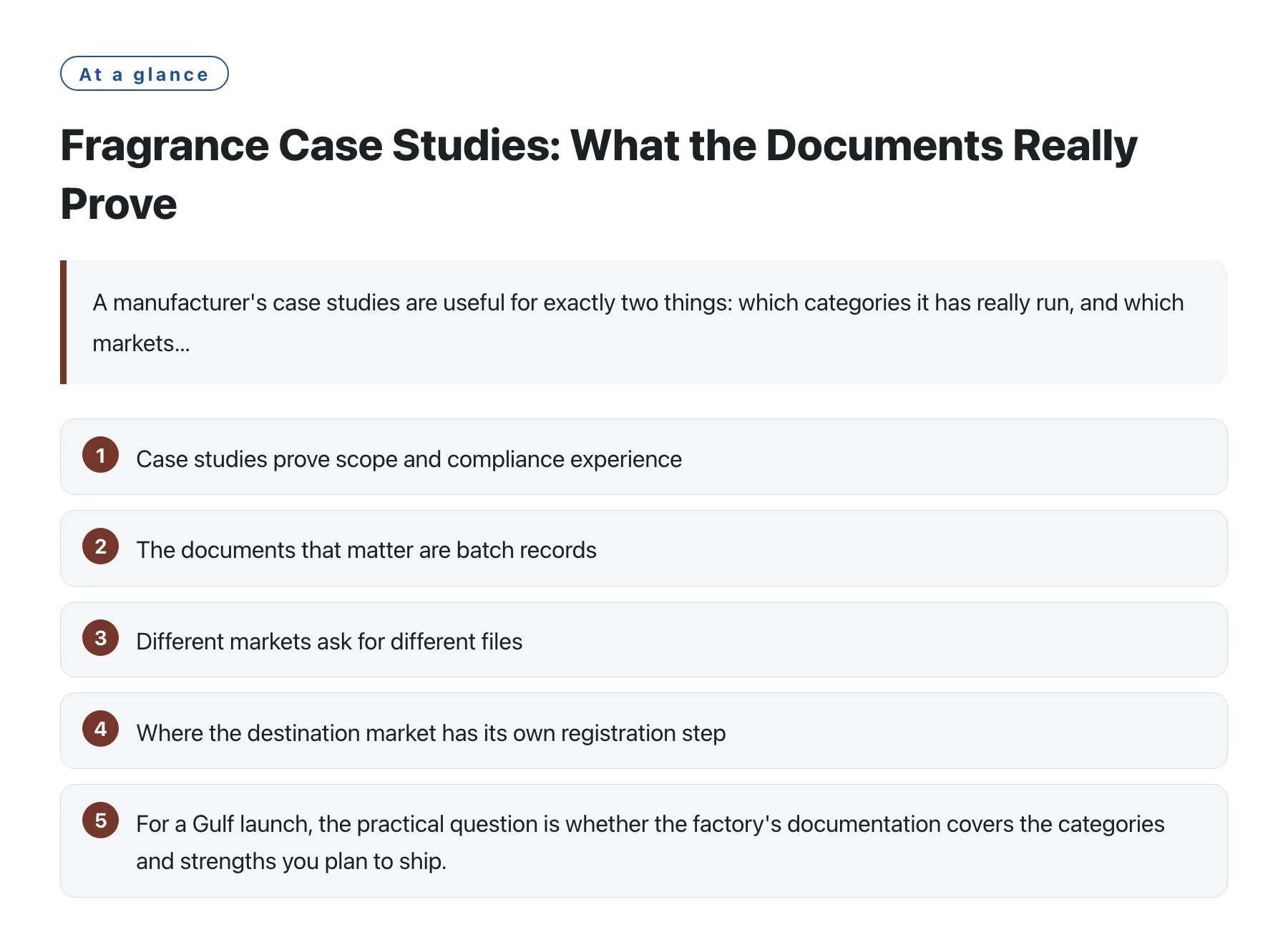
Key takeaways
- Case studies prove scope and compliance experience, not quality; treat every claim as a pointer to the document behind it.
- The documents that matter are batch records, ingredient files, restricted-material handling and the destination-market pack.
- Different markets ask for different files, so a manufacturer's export list is a map of the compliance it has already solved.
- Where the destination market has its own registration step, the brand's file still has to be assembled for that country, not imported wholesale.
- For a Gulf launch, the practical question is whether the factory's documentation covers the categories and strengths you plan to ship.
Case-study pages are the most viewed and least interrogated part of a manufacturer's website. Buyers read them for reassurance and then discover, mid-project, that the reassurance was category scope rather than production proof. This article proposes a different reading: treat each case as a claim, and ask which document would prove it.
The lens throughout is compliance — the file trail behind fragrance projects — because that is where a case study either becomes evidence or stays a story.
What a case study can and cannot prove
Ask what a case proves. It can prove category scope — whether the factory has genuinely run fine fragrance, home fragrance or scented body products. It can prove market scope, in the sense of which countries the documentation has actually passed. It can prove the volume shape, whether the factory is set up for small or large runs. What it cannot prove is quality, consistency or the temperament of the relationship — those live in batch records, release data and reference checks, not in the story.
This is why the reading order matters. The case list shows breadth; the batch records show depth, and a manufacturer's own description of its scope — for instance, presenting itself as a contract manufacturer for perfume brands across several categories — is only as useful as the documentation that backs the claim a contract manufacturer for perfume brands.
The category question
Match the case categories against your own plan: does the documentation experience cover fine fragrance at your strength, or home fragrance at yours? Category mismatch is the quietest source of rework in the industry, because the file, the filling line and the testing all differ.
The market question
The export list is a compliance map. A factory that lists regular shipping to a region has solved that region's file questions at least once; one that has never shipped there is learning the file for the first time, on your schedule. Ask which markets the documentation has genuinely passed.
What different markets ask for
| Market or region | Core documentation ask | Practical note |
|---|---|---|
| EU | Responsible person, product information file, safety assessment before sale | The PIF structure is the most widely copied template in the industry [1] |
| Canada | Notification before sale; restrictions via the ingredient hotlist | A useful second axis for testing a supplier's global file discipline [2] |
| Gulf (in practice) | Distributors commonly request files mirroring EU shape: certificate of analysis, restricted-material handling, product information | Ask which GCC markets the supplier has actually shipped to |
| Any market | Ingredient documentation tied to the finished formula's labelling obligations | Databases such as CosIng list the restrictions and labelling that apply to the finished product [3] |
Read the practical-note column first: it is what a buyer needs to know before asking for the file, and it is the part of the table that actually changes the launch calendar.
Reading the file behind the case
For each case that interests you, ask for three artefacts: the batch record of a representative run, the restricted-material handling document, and the export pack used for the destination market. A manufacturer that produces all three when asked has a file discipline; one that produces stories is doing marketing. Beyond the core file, EU rules also cover product claims and specific formulation topics, which matters when a brand's positioning makes claims that the documentation must be able to support [4].
Manufacturers that publish their own project cases invite exactly this conversation, because the claims are concrete enough to test. When a case-study page sets out the kinds of brands Xuelei has manufactured for brands Xuelei has manufactured for, the productive move is to ask for the documents behind the most relevant case — and to verify the stated certifications before the first formal meeting.
The three-artefact test in practice
The test works because it is cheap to run and expensive to fake. Any factory can produce one of the three; the discipline shows when all three arrive in the same folder, dated and coherent, without a follow-up call. The certification claims to cross-check are the ones a company states alongside its history and credentials — its background and certifications its background and certifications — verified by number and issuing body before any formal commitment.
Case studies will not save you; they will only point you. Point your questions at the documents behind the case that matters, and the documents — not the story — will decide the shortlist.
Applying the compliance lens to a Gulf launch
The Gulf launch reframes the exercise into three questions. First, do the manufacturer's documented categories match your plan? Second, does the documented export experience include the region, or at least markets with a similar file shape? Third, and most practical: when you name your product's categories, strengths and pack formats, can the factory answer with the documentation pack it has used for comparable products?
If the answers are yes, the case studies have done their job — they pointed you at a partner whose compliance is not an open question. If they are no, the case page becomes a reset: the file is the project, and the case studies were the introduction.
Sources
- European Commission: Cosmetics in the EU —— The European Commission's overview of EU cosmetics rules, including the responsible person, product information file and safety report requirements.
- Health Canada: Cosmetic Safety —— Health Canada's cosmetics pages, covering cosmetic notification, the ingredient hotlist and safety requirements for cosmetics sold in Canada.
- EU CosIng — Cosmetic Ingredient Database (European Commission) —— The European Commission's CosIng database of cosmetic ingredients, listing ingredient functions, restrictions and labelling requirements under EU cosmetics law.
- European Commission: Cosmetic Products — Specific Topics —— EU pages covering specific cosmetics topics such as product claims, nanomaterials and animal-testing rules.
Frequently asked questions
What should I ask for after reading a manufacturer's case studies?
Ask for three artefacts behind the most relevant case: a representative batch record, restricted-material handling documentation, and the export pack used for the destination market. All three arriving coherently is the signal that the case is real.
Can case studies prove product quality?
No. They prove category scope, market scope and volume shape, not quality or consistency. Quality lives in batch records, release-test data and retained samples, which is where the questions should go.
Why does the export list matter for compliance?
Because each market has its own file. A manufacturer that has shipped to a region has solved that region's documentation at least once; one that has not is learning it on your schedule.
What documents does a Gulf importer expect?
In practice, distributors in the region routinely request a file mirroring the EU shape: product information, restricted-material handling and a certificate of analysis. Ask which GCC markets the supplier has shipped to and which pack it used.
How do I verify the claims on a case-study page?
Treat every claim as a pointer to a document, then ask for the document. Certifications should be verified with the issuing body by number and scope, and batch records reviewed from intake to release. A case study is the start of that trail, not the end of it.